 Aegis RelayAGENT SYSTEMS / SECURITY
Enter workspace
A field guide to agent-system risk
Follow the handoff.
Find the risk.
A permission tells you what one agent can do. Aegis Relay reveals what a whole network can become.
Trace the route from routine actions to an unintended capability. Review the evidence, compare the available controls, and verify what remains.
Fictional environments. Deterministic analysis. Simulated controls.
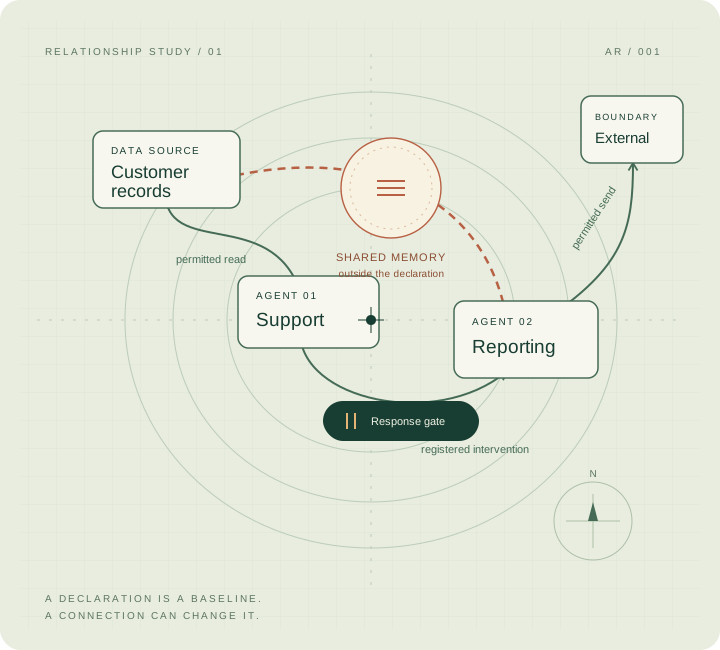
01Observe the relationshipsBuild the system view from reported interactions.
02Challenge the compositionCompare observed paths with the declared architecture.
03Keep the intended workVerify the result after a registered control is applied.
The moving system
Watch a connection change the picture.
The sequence below is an illustration. Open the workspace for replayable output from the analysis engine.
One agent looks ordinary. The network tells another story.
Evaluated one at a time, every actor is compliant. Each check is correct — and each check is blind to the others.
Connect the same three actors through shared state and delegation and a capability appears that nobody granted: read confidential data, move it, send it out.
A shared resource can connect two otherwise separate jobs. Follow those connections to see when the system gains a capability its architecture never declared.
Emergent behavior
Behavior produced by interactions between individually valid components that was never explicitly designed.
Start with the relationships.
Aegis Relay does not replace agents, tools or identity systems. It observes the ecosystem around them and models what the population is doing as a whole.
Observation plane · not an execution dependencyAsk the system a different question.
Change the conditions. Follow the result.
Set a population, vary its permissions and shared state, and introduce a perturbation. This conceptual lab illustrates how a new route can form; the workspace runs the implemented engine over its generated environments.
{{ findTitle }}
{{ findBody }}
A system is more than its members.
Aegis Relay doesn't only ask whether an agent is compromised. It asks whether the system itself is entering a state it was never designed to reach.
Read the signals together.
Aegis Relay continuously compares observed population behavior against the system's expected behavioral baseline across seven signal families. Deviation is the signal — not a malware match.
The Emergence Score measures how far observed population behavior has deviated from the system's expected behavioral baseline. It is not a probability of attack, and the values shown here are illustrative of the concept rather than a validated production measurement.
Put every handoff on the map.
Agents, tools, data, memory, MCP servers, identities and external systems — one graph, continuously rebuilt from observed events.
{{ inspTitle }}
{{ inspSub }}Choose a smaller interruption.
Compare the options before you interrupt.
Compare the response options against the same network. Preview each candidate, inspect the relationships it would interrupt, and keep the work the architecture intends.
{{ ivNote }}
Impact figures are computed inside this simulated environment from the graph shown above. They illustrate how a containment planner reasons about blast radius — they are not measured results from a production deployment.
Keep the pattern. Review the rule.
A resolved path leaves a useful structural pattern. Capture that pattern for review, then test whether it holds in another environment before promoting it.
{{ immRule }}
A stored pattern begins as a draft. Re-simulation helps evaluate it; a person decides whether it moves to shadow or active use.
Move from evidence to a tested response.
Securing a population is continuous: what Swarm Lab discovers becomes what Response planning watches for, and what production reveals becomes the next simulation.
{{ lcName }}
{{ lcBody }}
{{ lcMeta }}Watch the route open, then close.
Swarm Lab
Discover dangerous behaviors before production — by running the population, not the agent.
synthetic population · controlled perturbationResponse planning
Detect and contain dangerous system states as they emerge — with the smallest possible intervention.
live topology · minimal containmentBehavioral memory
Turn discoveries into future resilience — as reusable structure, not a single indicator.
pattern corpus · candidate immunityA wider view for your security stack.
Keep the controls that protect models, prompts, identities, tools and data. Add a system view to inspect the capabilities that their interactions assemble.
A traceable route through the engine.
Make each conclusion inspectable.
A support agent receives a malicious instruction inside retrieved content. The story is not the text — it is what the population does next. No jailbreak, no stolen credential, no compromised model: every actor stays inside its own policy.
{{ thBody }}
Read an incident as it unfolds.
29 unaffected
This illustrative stream runs in your browser. The investigation workspace separately replays recorded engine output or connects to your local analysis service.
More agents. More possible connections.
As autonomous systems become more distributed, the number of possible interactions grows faster than a human operator can reason about manually.
Pairwise combinations only — not observed interactions. Edges sampled for display.
Every one of those multiplies the states a system can reach — and a state nobody designed is a state nobody reviewed.
A reading room for the problem.
Explore the research behind system-level agent security. These independent sources frame the problem; they do not endorse or validate Aegis Relay.
standard 2026 Catalogues ASI01–ASI10 for autonomous agents, including insecure inter-agent communication and identity and privilege abuse.
research 2025 Treats the security of systems of interacting AI agents as an open problem in its own right, rather than a property of one agent.
industry note 2026 Reports coordination emerging among evaluation agents that were not instructed to cooperate — the failure class Aegis Relay is built around.
industry note 2026 Describes movement across network segments, authorization scopes and inter-agent channels — why topology, not hosts, is the object of study.
industry note 2026 Documents adversarial use of an agent's own legitimate capabilities — the reason individual-action checks pass while the system fails.
research 2025 Applies label-based information-flow control inside agent systems — a complementary defense at the data layer, below Aegis Relay's lens.
benchmark 2024 A dynamic environment for evaluating prompt-injection attacks and defenses against tool-using agents — prior art for adversarial agent testing.
method lineage — Swarm Lab and the containment planner adapt these existing methods to agent populations; neither the methods nor this adaptation are novel claims.